# General Information

# Welcome to Skywiki

**Skywiki** is a community knowledge base dedicated to **Skywalker and radiant coffee roasters**.

Here you’ll find guides on roasting theory, firmware, hardware modifications, and experiments created by the home roasting community.

Whether you're **new to the Skywalker** or building **custom controllers and firmware**, this site aims to collect and organize the most useful knowledge in one place.

---

## 🚀 Start Here

### New to the Skywalker?

Start with these guides:

- [Getting Started with the Skywalker<span class="ms-0.5 inline-block align-middle leading-none"></span>](https://www.youtube.com/watch?v=7sCwAg7CAzw&t=21s)
- [First Roast Walkthrough<span class="ms-0.5 inline-block align-middle leading-none"></span>](https://www.youtube.com/watch?v=xFYlgo7vNqE&t)
- <a class="decorated-link">Basic Safety and Setup<span class="ms-0.5 inline-block align-middle leading-none"></span></a>

---

## ⭐ Popular Guides

Some of the most useful resources on Skywiki.

- [Radiant vs Convection Roasting<span class="ms-0.5 inline-block align-middle leading-none"></span>](https://skywiki.coffee/books/general-information/page/convection-vs-radiant)
- [Setting Up HiBean](https://www.youtube.com/watch?v=R6ljbX7pgyM)
- [Artisan Setup Guide<span class="ms-0.5 inline-block align-middle leading-none"></span>](https://www.youtube.com/watch?v=RKWAE15qRdI&t)

---

## 💻 Firmware &amp; Electronics

For users building or modifying controllers.

- <a class="decorated-link">ESP32 Roaster Controller Guide<span class="ms-0.5 inline-block align-middle leading-none"></span></a>
- <a class="decorated-link">Artisan Integration<span class="ms-0.5 inline-block align-middle leading-none"></span></a>
- <a class="decorated-link">SkyCommand Firmware<span class="ms-0.5 inline-block align-middle leading-none"></span></a>
- <a class="decorated-link">Sensor Wiring (MAX6675 / PT100)<span class="ms-0.5 inline-block align-middle leading-none"></span></a>

---

## 📡 Communication Protocols

Documentation on how roasters communicate with software and controllers.

- <a class="decorated-link">Skywalker V1 Protocol<span class="ms-0.5 inline-block align-middle leading-none"></span></a>
- <a class="decorated-link">Cubean UART Packets<span class="ms-0.5 inline-block align-middle leading-none"></span></a>
- <a class="decorated-link">Temperature Decoding<span class="ms-0.5 inline-block align-middle leading-none"></span></a>

---

## 🔧 Hardware Mods

Community modifications and upgrades.

- <a class="decorated-link">Temperature Probe Mods<span class="ms-0.5 inline-block align-middle leading-none"></span></a>
- <a class="decorated-link">Airflow Modifications<span class="ms-0.5 inline-block align-middle leading-none"></span></a>
- <a class="decorated-link">Drum Motor Upgrades<span class="ms-0.5 inline-block align-middle leading-none"></span></a>
- <a class="decorated-link">Cooling Improvements<span class="ms-0.5 inline-block align-middle leading-none"></span></a>

---

## 🔥 Roasting Knowledge

Theory and deeper explanations about radiant roasting.

- <a class="decorated-link">Radiant Heat Transfer in Coffee Roasters<span class="ms-0.5 inline-block align-middle leading-none"></span></a>
- <a class="decorated-link">Why RoR Behaves Differently on IR Roasters<span class="ms-0.5 inline-block align-middle leading-none"></span></a>
- <a class="decorated-link">Heat Transfer Physics in Roasting<span class="ms-0.5 inline-block align-middle leading-none"></span></a>

---

## 🧪 Experiments &amp; Data

Testing and experiments performed by the community.

- <a class="decorated-link">IR Lamp Power Tests<span class="ms-0.5 inline-block align-middle leading-none"></span></a>
- <a class="decorated-link">Airflow Experiments<span class="ms-0.5 inline-block align-middle leading-none"></span></a>
- <a class="decorated-link">Drum Speed Experiments<span class="ms-0.5 inline-block align-middle leading-none"></span></a>

---

## 🌍 Community

Skywiki exists because of the home roasting community.  
  
**Discord** [Skywalker Community Discord](https://discord.gg/Bh75t3XrY6)

**YouTube**  
[https://youtube.com/@nirecue<span class="ms-0.5 inline-block align-middle leading-none"></span>](https://youtube.com/@nirecue)

**Website**  
[https://skywiki.coffee<span class="ms-0.5 inline-block align-middle leading-none"></span>](https://skywiki.coffee)

---

## 📚 About Skywiki

Skywiki is an open knowledge base designed to organize information that is often scattered across forums, Discord servers, and social media.

The goal is to preserve and share knowledge about **Skywalker and radiant coffee roasting systems**.

# Welcome

What is the Skywalker Roaster (SW/Skitop)?

- Skywalker Roaster is a Horizontal IR Drumroaster from Foshan Akimita Household co.

What so special about this roaster?

- The Skywalker roaster is priced affordably, currently under $420 as of 2/25/24. It offers easy modifiability and the option to integrate artisan through Arduino Nano or Leonardo via USB. Additionally, it boasts a thriving community of modders and roasters dedicated to enhancing its performance. However, the machine does come with its quirks, such as issues with the SCR experiencing thermal runaway, a subpar bean cooling system, and an ineffective air filter fan. Despite these drawbacks, enthusiasts continue to work on improving the overall functionality of the roaster

Where can I buy one?

- AliExpress from ITOP or GZZT [https://www.aliexpress.us/item/3256805948992600.html](https://www.aliexpress.us/item/3256805948992600.html "https://www.aliexpress.us/item/3256805948992600.html")
- Alibaba with a 5 order minimum from Foshan Akimata (FA) [https://www.alibaba.com/product-detail/Skywalker-Household-Drum-Coffee-Roaster-electric\_1600984858153.html](https://www.alibaba.com/product-detail/Skywalker-Household-Drum-Coffee-Roaster-electric_1600984858153.html "https://www.alibaba.com/product-detail/Skywalker-Household-Drum-Coffee-Roaster-electric_1600984858153.html")

# US Skywalker V2 Group Buy Update

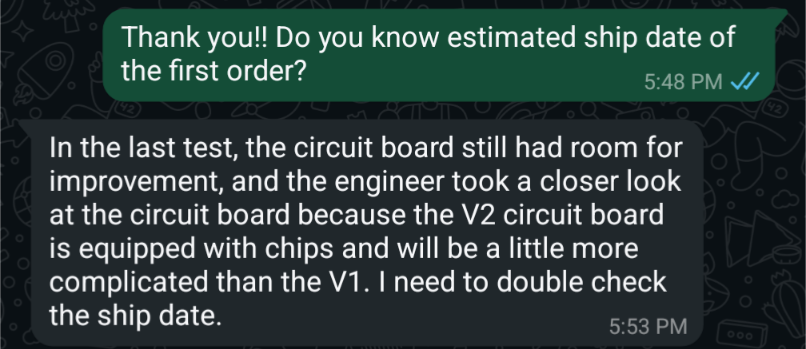
11/29: Original ship date delayed due to circuit board testing.  
[![ETA.png](https://skywiki.coffee/uploads/images/gallery/2024-11/scaled-1680-/eta.png)](https://skywiki.coffee/uploads/images/gallery/2024-11/eta.png)
# Skywalker V2: Before You Buy

The V2, Delta, Black Samurai or Cyber roaster the roaster has several different names but one that seems to stick is Skywalker. The V2 is the predecessor of the Skywalker V1 released in November 2023 seen on the Home Roasting Forum by Renatoa. The V1 is a electric drum roaster that utilizes a Far Infrared (FIR) lamp for coffee roasting similar in design elements as a Kaliedo and lamp setup like Rubbase style roaster. It offers a integrated bean cooler and exhaust filter fan both are regarded as fairly lack luster where exhaust filter fan is very close to useless. The main draw of the Roaster was not the aggressive edges of the front fascia inspired by Darth Vader or the FIR lamp but the cost of unit. For less than $500 you a fairly capable coffee roasting machine with a decent out of box experience. The popularity of the V1 grew even more when Artisan implementation was added with a simple Arduino Nano to communicated over serial USB by Jmoore. The modding community grew as well providing information regarding part replacements or mods to improve quality of life. The V2 was then soon announced boasting better controller board, touchscreen control panel, improved safety, and dual temperature monitoring at a $800 price point. A large batch of the V2 units were sent out and

# Renatoa Words of Wisdom

Here is a dedicated a page to information Renatoa has said. If you do not know who he is Renatoa is a person I considered to be the god father of the Skywalker. He was one of the first people to purchase one, break it down, predicted issues it would have and provided several of the first set of fixes. He is also the admin of the Home Roaster Forum and has been roasting for several years. I think he is a wealth of knowledge and a great asset to the home roasting community,  
  
Skywalker  
"It's simple: follow the heat."

<div dir="auto" id="bkmrk-it%27s-simple%3A-follow-">It's simple: follow the heat.</div><div dir="auto" id="bkmrk-as-in-criminal-foren">As in criminal forensic, follow the money.</div><div dir="auto" id="bkmrk-you-can-claim-you-kn">You can claim you know a machine when you can describe how the heat is produced, transferred and consumed.</div><div dir="auto" id="bkmrk-no-problem-being-a-p">No problem being a professional, there are a lot of high level drivers, even at top in F1, who don't know how they engine works, and worse, what to ask to the team to improve it. And they are driving whole live, millions of kilometres.</div><div dir="auto" id="bkmrk-i-know-it%27s-hard-for">I know it's hard for you to believe and/or accept, but Skywalker don't use hot air to roast beans... at all ! Conversely, the air steals heat from the beans.</div><div dir="auto" id="bkmrk-this-is-contrary-to-">This is contrary to all you know, and show how wrong is to judge an unknown thing on false premises.</div>  
  
On BT:

<div class="xdj266r x14z9mp xat24cr x1lziwak x1vvkbs" id="bkmrk-%22in-fact%2C-every-know"><div dir="auto">"In fact, every known method of measuring a moving mass of solid objects measures an average of the air temperature around the solids being measured.</div></div><div class="x14z9mp xat24cr x1lziwak x1vvkbs xtlvy1s" id="bkmrk-it-is-impossible-to-"><div dir="auto">It is impossible to accurately measure the surface of moving solid objects by point contact for such very short period of time, there is simply not enough heat transfer.</div></div><div class="x14z9mp xat24cr x1lziwak x1vvkbs xtlvy1s" id="bkmrk-for-this-reason%2C-you"><div dir="auto">For this reason, you will experience a relatively lower temperature for the final part of the roasting in the Skywalker compared to convection roasters, because in the Skywalker the air is cooler than the coffee beans, unlike convection, where the air is hotter than the coffee beans.</div></div><div class="x14z9mp xat24cr x1lziwak x1vvkbs xtlvy1s" id="bkmrk-this-behavior-is-due"><div dir="auto">This behavior is due to the radiant nature of the heating in the Skywalker. IR radiation does not heat transparent media it passes through, such as gases or glass!</div><div dir="auto">It is like the heat we get from the sun... the air gets its heat from ground radiation, not from the sun's rays. The further away from the Earth's surface it is, the colder it gets..."  
  
On Probes:  
  
<div dir="auto">"That's because the probe measure an average temperature of the air-beans mix.</div><div dir="auto">The air in this machine is cooler than the beans, unlike the most common commercial roasters, where is viceversa, air hotter than beans.</div><div dir="auto">For this reason for lower loads the probe measures a mix consisting of more air than beans, thus lower figures on display."</div>  
  
On Airflow:  
  
<div dir="auto">"Any change in this machine airflow will change dramatically the roast dynamics, don't do this !</div><div dir="auto">I can detect in my machine behavior even the switching between the three oven hood speeds, that lies about half meter above the roaster."  
  
On Skywalker Lamps:  
  
" <div class="xdj266r x14z9mp xat24cr x1lziwak x1vvkbs x126k92a"><div dir="auto">A well abused Skywalker... life expectancy.</div></div><div class="x14z9mp xat24cr x1lziwak x1vvkbs xtlvy1s x126k92a"><div dir="auto">This is the SKW of a fellow. Heater filament broke yesterday.</div><div dir="auto">9 months, 15 kg per month, thus about 135 kgs.</div><div dir="auto">Those who started using this machine for small production... should get a spare lamp asap.:"  
  
  
</div></div></div></div></div>

# Putrid_Upstairs Response

Best bet might be a Skywalker V1 or V2 for the price you want to maintain.

**Electric drum roaster (not hot top, I want precise repeatable control and proper temperature logging)**  
V1 has temperature logging done through either the use of Arduino Nano or ESP32-S3. The V1 firmware was developed by the community and made to work with Artisan and HiBean. We have implemented a PID library but needs some tuning. I do find that Hibean power tracking, which is basically event replication, worked just as well recreating a past roast by following heat and air changes made during the roast.

**Batch size: around 400–500 grams**  
V1 and V2 can do 500g but users like the 350g to 450g range.

**Should be able to handle a few back-to-back roasts without overheating or needing long cooldowns**  
V1 with heatsink mod is highly recommended where the V2 already has this installed. There are still a few people roasting back to back with the heatsink mod which is a little concerning. Then there is also putting running 40kg+ a month on a V1 which is not recommended.

**Temperature logging support (built-in or compatible with Artisan / similar software)**  
V1 doesn't have it built-in but the community basically taking all the bit banging going on in the roaster and converting that info into TC4 protocol to communicate with Artisan and HiBean. V2 has a serial usb option to connect to a PC and has Classic Bluetooth module that communicates with Artisan and HiBean (Android only at this time). No hardware PID in V2 they straight marketed that and ended using Artisan software PID with no shame.

**Budget: up to $1,000 USD (open to used options if they’re solid and parts are available)**  
V1 can be purchased for $450. V2 at around $720. The Skywalker parts readily available on Aliexpress. Community has also found places to source most of the consumable parts like lamps (FIR vs NIR), bearings, fans, and drum motors in case they ever stop producing them. We even have an open sourced controller board designed by a community member just in case.

**Prefer something that’s durable, consistent, and gives a realistic feel of commercial drum roasting**  
That's hard to come by you would need to save up to $2k or more and get something like a Cormorant, Kaliedo or Bullet.

**Which models you’d recommend (and why)**  
V1 and like extra $20 in mods gets you a pretty great setup for roasting staying well under $1k.

**Pros/cons of electric drum roasters you’ve used**  
Kaliedo M2 awesome build quality, pretty design and lots of happy users out there. It just cost so much more and I get similar results to my V1. Also if you are out of warranty and that controller board dies that will cost $400USD to replace. I would upgrade to a M10 for sure before getting a M2.

Smola S5 another decent sub $800 500g roaster. Build quality is better than the Skywalker lots of metal but design aesthetics is Spartan. Still early needs lots of revisions like the switching metal parts to wooden so they wont burn your hand when roasting. The internal Bean Cooling Fan is worse than the Skywalker. Heat lamp is out of the drum so it's more similar to a Kaliedo convection dominant roaster than a radiant dominant roaster like a Skywalker. It also connects to Artisan and Hibean off the bat (firmware updated required).

Kaffelogic Nano 7. I paid $1k and it's cool for what it is. Set a profile and it roasts. Roasts come out great but only 150g batches. Also I have a little more fun manually roasting managing things like heat% and air exhaust. I feel like I learn more on a Kaliedo or a Skywalker. Especially both have triers great ways to monitor progress of your roast by seeing and smelling.

Skywalker V1 and V2 (All Cons). Right away the build quality is sub par when compared to a Kaliedo or Bullet. This V1 feels like it had two design philosophy in mind. 1) How can we build a decent roaster at a production cost of $150 2) How can I make it look cool (old marketing went heavy on the Vader images). Things like thermal runaway was a big problem in first batch of V1. They eventually added some extra safety fuses and relays to the board which work and eventually added a heatsink fan to V2. Drum motor does have some issues especially with back to back roasts. Not just one or two but like 5 hour sessions the internal gear is made of some plastic. We did source a similar motor with all metal gears and there is a brushless version of the motor that can be added to the V1 with some tinkering. Also the V1 controller and V2 tablet are pretty bad. The 1Kg version of the Skywalker is the only one with a decent controller.

**What software/hardware setup you use for logging**  
HiBean mostly they have large release coming out soon where community can share their profiles. Like [https://www.roastetta.com/](https://www.roastetta.com/)

**Any accessories or modifications that improve consistency (e.g. probes, airflow tweaks, etc.)**  
For my V1 I was able to get probes like a K style TC and a PT100 RTD swap out the our NTC probe (you still need to use proper MAX Amplifier and the right firmware to use).

If you have any questions or want to talk over Discord Video Stream feel free to find me on our [Skywalker Community Discord](https://discord.gg/Bh75t3XrY6)

If you are in Northern California you can take one for a spin. We had a Roast It Forward program but shipping became too prohibited and didn't get enough feedback from the first two people who were picked.

# Infrared Roaster

<span style="color:rgb(187,187,187);font-family:'-apple-system', 'system-ui', 'Segoe UI', Oxygen, Ubuntu, Roboto, Cantarell, 'Fira Sans', 'Droid Sans', 'Helvetica Neue', sans-serif;font-size:3.425em;font-weight:400;">Skywalker Roaster</span><span style="color:rgb(187,187,187);font-family:'-apple-system', 'system-ui', 'Segoe UI', Oxygen, Ubuntu, Roboto, Cantarell, 'Fira Sans', 'Droid Sans', 'Helvetica Neue', sans-serif;font-size:3.425em;font-weight:400;"> Key Characteristics and Behavior</span>

There are two main peculiarities of this machine that must be clearly understood:

### 1. High Thermal Inertia — But Not From the Drum

This roaster has very high thermal inertia, comparable to a commercial drum machine — but for a different reason.

In a traditional drum roaster, inertia comes from the **thermal mass of the drum and structure**.  
In this machine, inertia comes primarily from the **infrared heating element (lamp)**.

The lamp does not respond instantly to power changes. Even after reducing power, it continues emitting significant radiant energy. As a result:

- Power changes have delayed effects.
- The rate of rise (RoR) reacts slowly.
- Large adjustments cause overshoot or collapse.

You are steering a *Titanic*, not a jetski.

---

### 2. It Is NOT a Hot-Air (Convection-Dominant) Machine

Most small roasters operate thermodynamically like a body immersed in a hot convective environment.

This machine does not behave that way.

Heat transfer here is primarily **radiative**, not convective.

That means:

- The air is not the main heat carrier.
- The drum mass is not the main heat reservoir.
- The infrared radiation directly heats the beans.

This requires a completely different mindset compared to convection roasters.

---

## Data and PID Control

Collecting roast data is absolutely useful but not for tight real-time PID control.

Trying to aggressively PID this machine is largely counterproductive because:

- The heater response is slow.
- Thermal inertia is high.
- The system overshoots easily.

Instead, use roast data to:

- Understand machine response characteristics.
- Plan future profiles carefully.
- Adjust timing, not constant power modulation.

This roaster prefers **few deliberate power changes**:

- 3–5 adjustments per roast are usually sufficient.
- The key variable is *when* to change power, not constant micro-adjustments.
- Heat step magnitude should be modest (5–10%), similar to gas drum roasters.

In contrast, on a convection roaster, you can sometimes maintain nearly constant power and achieve stable results.

---

# Empty Machine Experiment

## Setup

- Roaster run empty (no beans)
- Program: P11 (light natural roast preset)
- Preheat: 200°C
- Heater: 65%
- Fan: 65%

### Automated Program Behavior

At 170–172°C:

- Heater reduced to 40%
- Fan increased to 90%

Without beans:

- Temperature plateaued at ~178°C (177–179°C oscillation)
- After 15 minutes, system timed out and entered cooling
- It could not exceed 179°C

---

# Surprising Observation

During a real roast with beans:

- P11 cutoff temperature reaches ~194°C

Without beans:

- It cannot heat beyond ~179°C

This reveals something important.

It does **not** mean the beans are the primary heat source.  
It means the beans are the **primary energy absorbers and thermal mass** in the system.

---

# Corrected Physics Explanation

## Radiation Dominates

The infrared lamp emits radiation. That radiation:

- Is absorbed efficiently by dark organic material (coffee beans)
- Is poorly absorbed by air (air is largely transparent to IR)
- Is partially reflected by shiny metals
- Is absorbed moderately by darker drum surfaces

This aligns with radiation physics and blackbody absorption principles. Dark, matte objects absorb radiation well.

---

---

# On First Crack Temperature (~182°C)

The relatively low FC reading is likely due to:

- Probe placement near bean mass
- Radiant-dominant heat transfer
- Less superheated air compared to convection machines

It is not necessarily probe miscalibration.

This roaster’s temperature readings represent a different thermal environment than hot-air roasters.

---

# Design Implications

If the drum were polished stainless steel:

- Radiation reflection would increase.
- Bean heating efficiency would decrease.
- The system would struggle more to heat.

A darker drum improves radiative absorption.

---

# Practical Takeaways

- Use fewer, deliberate power changes
- Think in timing adjustments rather than constant PID modulation
- Expect delayed RoR response
- Understand that radiation is dominant
- Do not compare temperature numbers directly with hot-air machines

# Convection Vs Radiant

This was summarized by Renatoa he runs the Home Roaster Forum.

[![image.png](https://skywiki.coffee/uploads/images/gallery/2026-03/scaled-1680-/Cloimage.png)](https://skywiki.coffee/uploads/images/gallery/2026-03/Cloimage.png)

A flat RoR indicates how radiation delivers energy relative to bean temperature. Difference comes from underlying heat transfer physics. Convection heat transfer rate follows Newton's Law of Cooling/Heating.

Q=hA(Tair​−Tbean​)  
Where:

Q = heat transfer rate  
h = heat transfer coefficient  
A = surface area  
T\_air = air temperature  
T\_bean = bean temperature

At the start T\_air transfers to T\_bean lots of heat high RoR. Once beans heat up less heat trasnfer and RoR declines. So if your heat input stays constant, RoR falls naturally.

[![image.png](https://skywiki.coffee/uploads/images/gallery/2026-03/scaled-1680-/nxqimage.png)](https://skywiki.coffee/uploads/images/gallery/2026-03/nxqimage.png)

Radiant heating behaves differently follows Stefan–Boltzmann law:

Q=σϵ(Tsource4​−Tbean4​)  
Where:  
σ = Stefan–Boltzmann constant  
ε = emissivity (how well beans absorb radiation)  
T\_hot = IR lamp temperature  
T\_cold = bean temperature

Lamp placement and heat get's really hot. If the formula raises temperature to the power of four energy input stays nearly constant. If Energy input remains constant and the temperature increase stays roughly constant flat RoR is produced. Then there is emissivity effect beans darken and emissivity increase. Beans absorb more IR energy later in roast so if you were to reduce heater power after drying the energy input would roughly remain constant that returns back to flat RoR.  
  
TLDR: Flat RoR in a radiant roaster = stable energy delivery, while in convection a flat RoR usually means increasing energy input (which can taste baked or dull).

# Overheating Drum Motor

The Skywalker is no stranger to overheating issues. One of the first big issues was thermal runaway due to overheating thyristor. Now with the increasing reports of E3 errors and drum motors no longer turning the issue of overheating drum motor is the next big issue that needs to be tackled.   
  
  
The drum motor gets hot to the point where it's causing plastic internal gears to [strip](https://youtu.be/NAbl9kdY2GU?si=aHbLbhgtd6qbSznW)

[![image.png](https://skywiki.coffee/uploads/images/gallery/2026-03/scaled-1680-/7Wtimage.png)](https://skywiki.coffee/uploads/images/gallery/2026-03/7Wtimage.png)

Several users reporting temperatures as high as 127C. With a thermocouple placed on the body of the motor and labeled under ET I had reached drum motor temps up to 122C.

[![image.png](https://skywiki.coffee/uploads/images/gallery/2026-03/scaled-1680-/Xkpimage.png)](https://skywiki.coffee/uploads/images/gallery/2026-03/Xkpimage.png)

Because the motor is enclosed with not wat